
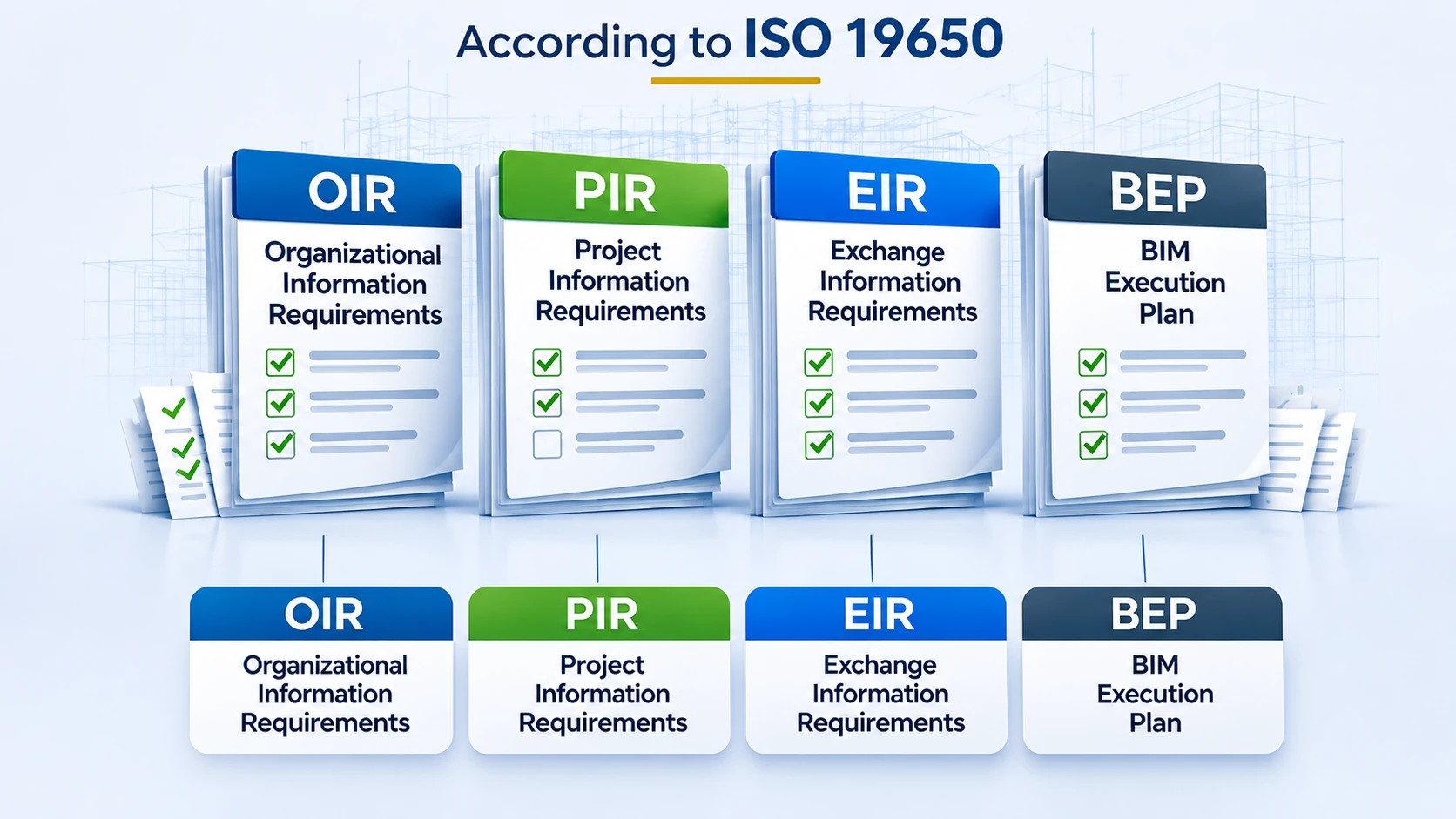
Applying the standard is about far more than building a 3D model. It means defining what information is required, who is responsible for it, when it is due, and the status that allows it to be shared or used.
This guide covers the key ISO 19650 requirements, the EIR, BEP, and MIDP documents, and how deliverables are managed through the common data environment (CDE).
What Is ISO 19650, and Why Does It Matter on Gulf Projects?
ISO 19650 is a series of international standards for managing information over the whole life cycle of a built asset, using Building Information Modeling (BIM).
ISO 19650-1 sets out the concepts and principles, while ISO 19650-2 covers the information management requirements for the delivery phase of assets, including design and construction.
The framework matters most on projects that need coordination across several disciplines, such as architecture, structure, and mechanical, electrical, and plumbing (MEP) systems.
In Saudi Arabia and the UAE, ISO 19650 may be required by the project owner or the contract documents, depending on the scope and the owning entity. Always check the contractual and regulatory requirements of each project rather than assuming the standard is mandatory everywhere.
Who Is Responsible for Delivering BIM Information?
Responsibility for managing BIM information is usually shared among three main parties:
Appointing party: the party that defines the information requirements, usually the project owner or its representative.
Lead appointed party: the party responsible for managing and coordinating the delivery of information within its appointment, such as the lead consultant or the main contractor, depending on the project structure.
Appointed parties: the teams and firms that produce the information and engineering models for their own disciplines, such as the architecture, structure, and MEP teams.
Responsibilities and delivery dates should be documented from the start of the project to avoid overlapping roles or missing information when the models are reviewed.
The Key Documents for Managing and Delivering BIM
A set of linked documents turns the project owner's requirements into a clear plan for production and delivery.
| Document | Main purpose |
|---|---|
| EIR – Exchange Information Requirements | Defines the information required at each information exchange, including its purpose, content, and level of information need |
| BEP – BIM Execution Plan | Explains how the information management requirements will be met, including team organization, working methods, coordination, and delivery |
| TIDP – Task Information Delivery Plan | Sets out the deliverables, dates, and responsibilities of each task team |
| MIDP – Master Information Delivery Plan | Brings the teams' delivery plans together into one coordinated master plan |
| Information Standard | Sets the agreed rules for file naming and for structuring and coding data |
| Information Production Methods and Procedures | Describes how information is produced, reviewed, authorized, and shared |
Worked example: If the project owner requires a coordinated MEP model at the end of detailed design, the information required and its acceptance criteria must be clear, and the delivery plan must set out the responsible party, the expected date, and the review procedure before the model is submitted.
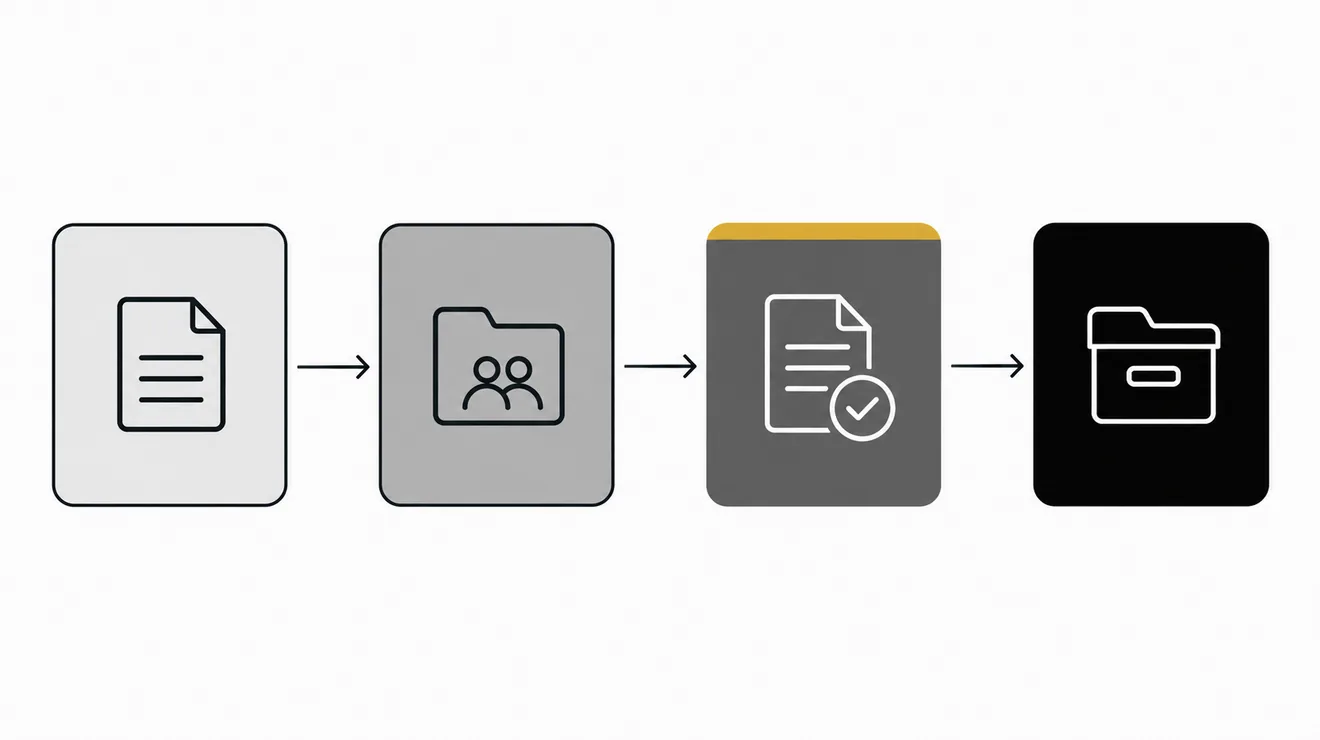
The Common Data Environment (CDE) and the Four Information States
The common data environment (CDE) is used to manage and exchange project files and information under clear procedures for controlling versions, statuses, and permissions.
As ISO 19650 is commonly applied, the main information states are:
1. Work in Progress (WIP)
Information still being prepared or reviewed internally by the task team, and not yet cleared to be shared outside it.
2. Shared
Information cleared to be shared with the relevant teams, such as MEP models used for coordination and clash detection.
3. Published
Information that has completed the required review and authorization and is available for its intended use, according to its suitability status and approved purpose.
4. Archived
The retained record of information and its earlier revisions, so that changes and information exchange decisions can be traced.
It is important to distinguish between the status of information in the CDE and contractual approvals or construction permits: moving a file to Published does not automatically approve every use of it.
The Level of Information Need and How It Relates to LOD
A common mistake is to assume that applying ISO 19650 means holding every model to a fixed level of detail, such as LOD 300 or LOD 400.
In fact, the standard relies on the Level of Information Need, which defines how much geometric and non-geometric information and documentation is needed to achieve a given purpose.
Numbered LOD levels belong to other frameworks and specifications, and should not be treated as fixed requirements imposed by ISO 19650.
For example, an MEP coordination team may need the actual sizes, positions, and levels of ducts and pipes without modeling every fabrication detail at the same stage.
The level of information required should therefore match the project stage, the purpose of the model, and the agreed delivery requirements.
What Do BIM Deliverables Usually Include?
Deliverables vary with the contract and the project stage, but they may include:
- BIM models for the architectural, structural, mechanical, electrical, and plumbing disciplines.
- Federated coordination models to check that the disciplines fit together.
- IFC files where models must be delivered in an open format.
- Clash detection reports and records of how clashes were resolved.
- Engineering drawings extracted from, or consistent with, the approved models.
- Delivery plans and the BIM information management documents.
- Asset and equipment information for operation and maintenance, including COBie where the requirements call for it.
Delivering an IFC file alone does not fulfill the BIM obligations: the required data must be present, and the model must meet the project's acceptance criteria.
Practical Steps for Organizing BIM Deliverables Under ISO 19650
To manage information better and reduce rework, follow this sequence:
- Define the requirements: review the EIR and contract documents, and identify the information required and its intended uses.
- Prepare the execution plan: set out the task teams, responsibilities, coordination methods, and information management procedures in the BEP.
- Plan the deliverables: prepare a TIDP for each team and combine them into the MIDP, with dates and review points.
- Produce and coordinate the models: develop the engineering models and run quality checks and clash detection.
- Review and share the information: check that files meet the requirements before they move between CDE states.
- Deliver and record: submit the authorized information for its stated purpose, keeping a clear record of revisions and review results.
This approach reduces ambiguity about responsibilities and makes decisions and information exchanges between project participants easier to trace.
Frequently Asked Questions About ISO 19650 and BIM Deliverables
Is ISO 19650 mandatory in Saudi Arabia and the UAE?
ISO 19650 cannot be considered mandatory for every project in either country. Whether it applies depends on the owning entity, the project type, the contract documents, and the relevant regulations.
What is the difference between the EIR and the BEP?
The EIR defines the information the appointing party requires and the purposes it serves, while the BEP explains how those requirements will be managed and how the information will be produced, coordinated, and delivered.
What is the difference between the TIDP and the MIDP?
The TIDP sets out each task team's planned deliverables, while the MIDP combines the teams' plans into one integrated master plan that coordinates dates and responsibilities.
Is an IFC file required on every BIM project?
Not necessarily. Whether IFC is required depends on the project requirements and the agreed formats. The client may ask for native model files, IFC, or both.
Does ISO 19650 require LOD 300 or LOD 400?
No. The level of information need should be set by the purpose the information serves and the project stage. Specific LOD levels can be agreed upon in the project specifications where appropriate.
Must COBie be included in the final handover?
COBie is required when the information requirements or the contract documents call for it. The scope of asset data depends on the owner's operation and maintenance needs.
What does ISO 19650 require from the main contractor (principal contractor)?
When the main contractor is the lead appointed party for the construction stage, it leads information management for its delivery team. It agrees on the BIM execution plan with the client, sets the information requirements for its subcontractors and suppliers, combines their TIDPs into the MIDP, checks and authorizes the information they produce, and submits it for the client’s acceptance at each agreed milestone.
Does ISO 19650 apply to government projects in Saudi Arabia and the UAE?
It applies when the public owner writes it into the tender or contract documents. Government entities and large public programs often set their own BIM requirements, and some of them reference ISO 19650. Before bidding, check the exchange information requirements (EIR), the BIM execution plan the owner expects, the specified common data environment, and the handover data needed for operation.
How We Support the Production and Delivery of BIM Models
At Al Abbas Engineering Consultants, we focus on producing engineering models and drawings and on coordinating building disciplines, especially MEP systems.
Our services cover the modeling of HVAC, mechanical, electrical, and plumbing systems; coordination between disciplines; clash review; and shop drawings and digital deliverables tailored to each project's requirements.
We aim to deliver well-organized engineering information that can be coordinated and reviewed, supporting design and construction teams on projects across the Gulf.
Need engineering support with BIM modeling or MEP coordination on your project?